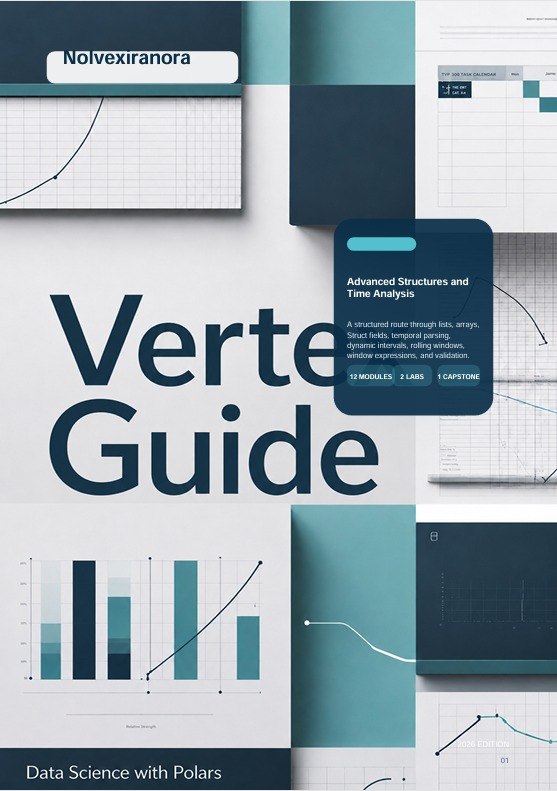
Nolvexiranora
Vertex Guide
Vertex Guide
Couldn't load pickup availability
- 📄 Digital file available after purchase
- 🗂️ Long-term availability
- 🛡️ Secure checkout
- 🗓️ Content updated in 2026
Self-paced learning overview
Share
Problem Statement
As analytical projects become more detailed, learners may begin working with nested values, lists, structured columns, irregular timestamps, and calculations that depend on several related conditions.
These situations can make a workflow difficult to read. A single column may contain grouped values, a timestamp may require several preparation steps, or a calculation may need to compare records across categories and time periods.
Solution
Vertex Guide introduces advanced Polars concepts through clearly divided analytical patterns. Learners study how to work with list and structured columns, prepare time-based information, create rolling and dynamic calculations, and arrange complex expressions into reusable sections.
The course emphasizes gradual development. Each advanced operation is first examined on a small dataset before being connected to a broader workflow.
Learners also study how to test individual transformation stages, name intermediate expressions, and document the purpose of more complex analytical logic.
What’s Inside
Vertex Guide contains modules on list expressions, structured columns, nested data expansion, date and time preparation, rolling calculations, dynamic grouping, advanced window expressions, reusable expression builders, and workflow testing.
The materials include annotated examples, structural diagrams, comparison tables, exercises, review questions, and a detailed course project.
The project guides learners through preparing event-based data, organizing nested values, calculating time-based measurements, and producing a structured analytical summary.
Who Is This For?
Vertex Guide is intended for:
- Learners with experience in Polars workflows
- Analysts working with time-based information
- Developers handling nested or structured datasets
- Students studying advanced expression design
- Learners who want to organize complex logic more clearly
- People building reusable analytical components
- Anyone interested in detailed data transformation patterns
What You’ll Learn
- Identify list and structured column types
- Expand nested values into readable formats
- Extract fields from structured columns
- Apply expressions to values inside lists
- Prepare date and timestamp columns
- Extract time units for analysis
- Group records by time intervals
- Create rolling calculations across ordered data
- Build dynamic time-based summaries
- Apply advanced window expressions
- Compare values within categories and time periods
- Combine several conditions inside one calculation
- Create named expression groups
- Reuse analytical logic across related workflows
- Test complex transformations in smaller stages
- Review schemas after nested data operations
- Document advanced analytical decisions
- Produce a final time-based summary dataset
30-Day Refund Policy
Vertex Guide includes a 30-day refund request period, subject to the terms presented on the website. Learners may review the policy before completing a purchase.
Certification
The course includes a certificate of completion, giving learners a clear way to confirm their progress and present a record of the course they completed.
Do I need previous data science experience?
Do I need previous data science experience?
No previous experience is required for introductory tiers. The courses begin with clearly explained concepts and gradually introduce data structures, analytical expressions, workflow planning, and practical data tasks.
How are the courses organized?
How are the courses organized?
Each course is divided into structured modules containing explanations, examples, guided exercises, review sections, and practical activities. Learners can follow the modules in sequence or return to earlier topics when reviewing a concept.
Does every tier include a certificate?
Does every tier include a certificate?
Yes. Each course includes a certificate of completion. The certificate gives learners a clear record that they completed the included lessons, exercises, and course sections.