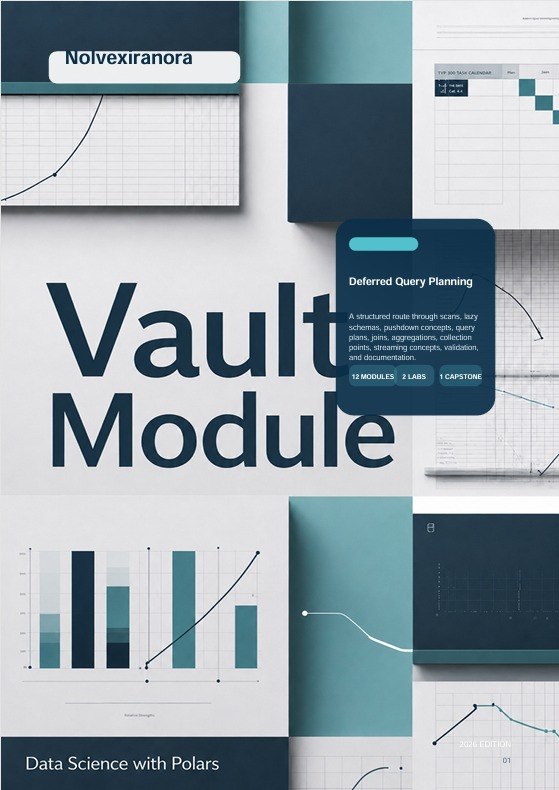
Nolvexiranora
Vault Module
Vault Module
Couldn't load pickup availability
- 📄 Digital file available after purchase
- 🗂️ Long-term availability
- 🛡️ Secure checkout
- 🗓️ Content updated in 2026
Self-paced learning overview
Share
Problem Statement
As datasets grow, workflows that worked well on smaller files may become harder to manage. Repeated materialization, unnecessary column selection, duplicated calculations, and poorly ordered transformations can increase processing demands and make analytical logic more difficult to review.
Learners may also understand individual operations without knowing how query planning affects the order in which those operations are carried out. This can lead to workflows that contain correct calculations but use an inefficient structure.
Another common issue is applying every transformation immediately. When each stage creates a separate intermediate dataset, the overall process can become longer, harder to inspect, and more demanding on available resources.
Solution
Vault Module introduces deferred workflow planning and explains how Polars can organize multiple transformations before producing a final result.
Learners study how to scan data, select only relevant columns, filter records earlier in the workflow, review query plans, and collect results at appropriate points. The lessons compare immediate and deferred execution so learners can understand where each approach fits.
The course also emphasizes readable structure. Analytical steps are divided into logical stages, with validation checks added before final output creation.
What’s Inside
Vault Module contains modules on immediate and deferred workflows, data scanning, query plans, projection selection, predicate filtering, collection points, streaming concepts, schema review, and resource-aware transformation design.
The materials include annotated examples, workflow comparisons, query-plan diagrams, practical exercises, review questions, and a detailed analytical project.
The project guides learners through organizing a larger dataset workflow, reducing unnecessary operations, checking intermediate assumptions, and preparing a final analytical table.
Who Is This For?
Vault Module is intended for:
- Learners familiar with multi-stage Polars workflows
- Analysts working with larger structured datasets
- Developers organizing repeated transformation tasks
- Students studying query planning concepts
- Learners comparing immediate and deferred execution
- People who want to reduce unnecessary intermediate steps
- Anyone interested in clearer resource-aware workflow design
What You’ll Learn
- Explain the difference between immediate and deferred execution
- Build a deferred analytical workflow
- Scan structured data without loading every stage immediately
- Select relevant columns early in a process
- Apply filters before later transformations
- Review the logical order of analytical operations
- Read and interpret a query plan
- Identify unnecessary transformations
- Reduce repeated calculations
- Choose suitable collection points
- Compare workflow structures using row and schema checks
- Organize joins and aggregations within deferred plans
- Examine streaming-oriented processing concepts
- Separate planning, validation, and output stages
- Document resource-related workflow decisions
- Refine a larger workflow into a clearer analytical sequence
30-Day Refund Policy
Vault Module includes a 30-day refund request period, subject to the terms presented on the website. Learners may review the policy before completing a purchase.
Certification
The course includes a certificate of completion, giving learners a clear way to confirm their progress and present a record of the course they completed.
Do I need previous data science experience?
Do I need previous data science experience?
No previous experience is required for introductory tiers. The courses begin with clearly explained concepts and gradually introduce data structures, analytical expressions, workflow planning, and practical data tasks.
How are the courses organized?
How are the courses organized?
Each course is divided into structured modules containing explanations, examples, guided exercises, review sections, and practical activities. Learners can follow the modules in sequence or return to earlier topics when reviewing a concept.
Does every tier include a certificate?
Does every tier include a certificate?
Yes. Each course includes a certificate of completion. The certificate gives learners a clear record that they completed the included lessons, exercises, and course sections.