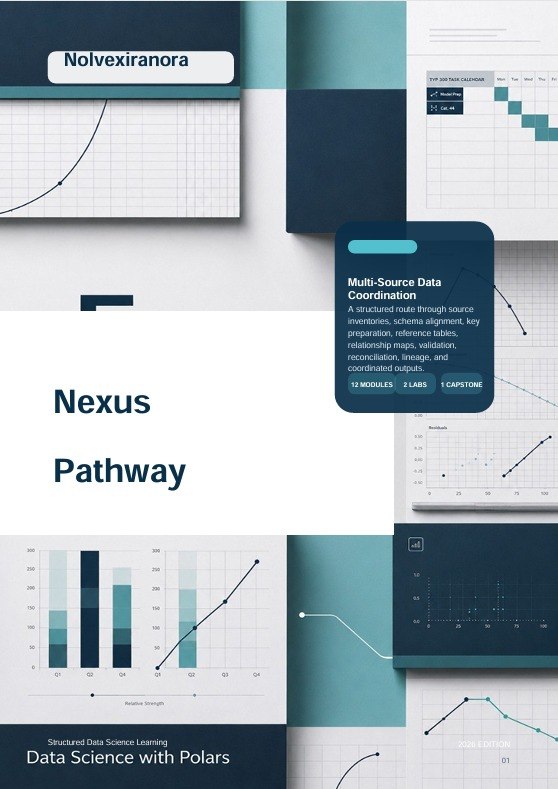
Nolvexiranora
Nexus Pathway
Nexus Pathway
Couldn't load pickup availability
- 📄 Digital file available after purchase
- 🗂️ Long-term availability
- 🛡️ Secure checkout
- 🗓️ Content updated in 2026
Self-paced learning overview
Share
Problem Statement
Larger analytical projects often involve information from several departments, periods, categories, or file structures. Each source may use different column names, data types, identifiers, and update schedules.
Even when individual transformations are correct, the complete project may become difficult to manage. Join logic may appear in several places, calculation rules may be repeated, and changes to one dataset may affect several later outputs.
Projects also become harder to explain when data relationships, calculation rules, and validation decisions are not recorded clearly.
Solution
Nexus Pathway presents advanced analytical work as a connected system of defined stages. Learners study how to map relationships between datasets, standardize incoming structures, organize reusable transformation components, and add validation routines throughout the workflow.
The course explains how to separate shared preparation logic from dataset-specific operations. Learners also explore dependency planning, structured configuration, reference tables, and consistent output design.
Each module uses review points to help learners examine schemas, identifiers, row counts, category coverage, and calculated values before moving to later stages.
What’s Inside
Nexus Pathway contains modules on multi-source workflow planning, data relationship mapping, standardized ingestion, reference-table design, reusable transformation components, dependency management, validation layers, analytical reconciliation, output coordination, and project documentation.
The materials include architecture diagrams, annotated workflows, planning tables, guided exercises, review questions, validation checklists, and a detailed course assignment.
The assignment involves connecting several related datasets, applying shared preparation rules, validating joins, calculating analytical measures, and producing a coordinated collection of summary tables.
Who Is This For?
Nexus Pathway is intended for:
- Learners experienced with advanced Polars workflows
- Analysts managing several related data sources
- Developers building reusable analytical structures
- Students studying data workflow architecture
- People coordinating repeated reporting processes
- Learners working with reference and transaction tables
- Teams reviewing shared data science projects
- Anyone interested in organized multi-source analysis
What You’ll Learn
- Map relationships between several datasets
- Identify primary and secondary key columns
- Standardize column names across incoming sources
- Align data types before joins and comparisons
- Build reusable preparation components
- Separate shared logic from source-specific transformations
- Organize workflow dependencies in a clear order
- Create and apply reference tables
- Validate one-to-one and one-to-many relationships
- Detect unmatched, duplicated, or unexpected identifiers
- Compare totals before and after table combinations
- Add schema checks throughout a workflow
- Reconcile calculated values across related outputs
- Manage category mappings and naming conventions
- Coordinate several analytical summary tables
- Record data lineage between inputs and outputs
- Document calculation rules and assumptions
- Review the effects of source-data changes
30-Day Refund Policy
Nexus Pathway includes a 30-day refund request period, subject to the conditions displayed on the website. Learners may review the full policy before completing a purchase.
Certification
The course includes a certificate of completion, giving learners a clear way to confirm their progress and present a record of the course they completed.
Do I need previous data science experience?
Do I need previous data science experience?
No previous experience is required for introductory tiers. The courses begin with clearly explained concepts and gradually introduce data structures, analytical expressions, workflow planning, and practical data tasks.
How are the courses organized?
How are the courses organized?
Each course is divided into structured modules containing explanations, examples, guided exercises, review sections, and practical activities. Learners can follow the modules in sequence or return to earlier topics when reviewing a concept.
Does every tier include a certificate?
Does every tier include a certificate?
Yes. Each course includes a certificate of completion. The certificate gives learners a clear record that they completed the included lessons, exercises, and course sections.