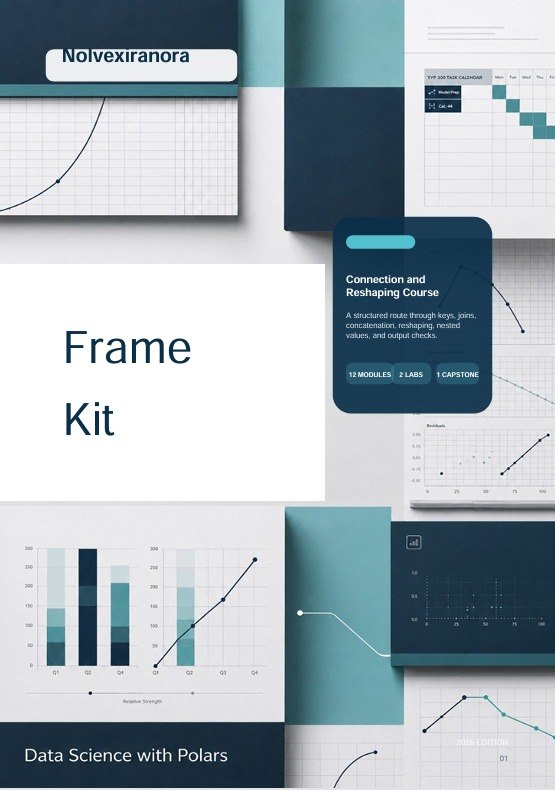
Nolvexiranora
Frame Kit
Frame Kit
Couldn't load pickup availability
- 📄 Digital file available after purchase
- 🗂️ Long-term availability
- 🛡️ Secure checkout
- 🗓️ Content updated in 2026
Self-paced learning overview
Share
Problem Statement
Real data tasks often involve more than one table. Customer details may be stored separately from orders, category information may appear in another file, and dates or identifiers may use different formats across datasets.
Learners who understand basic cleaning may still find it difficult to decide how tables should be connected. An unsuitable join type, mismatched key column, or repeated identifier can create missing rows, duplicated records, or confusing results.
Reshaping data can present another challenge. Information may be arranged across many columns when it would be more useful in rows, or repeated categories may need to become separate columns for reporting.
Solution
Frame Kit explains how to examine relationships between datasets before combining them. Learners study key columns, matching values, join types, row counts, and schema compatibility.
The course also introduces practical reshaping methods. Each module shows how data changes during an operation and explains how to review the result before moving to the next step.
What’s Inside
Frame Kit contains modules covering vertical and horizontal concatenation, table joins, key preparation, suffix handling, nested structures, column expansion, pivot-style organization, unpivoting, and multi-table workflow design.
The materials include guided examples, relationship diagrams, comparison tables, review questions, workflow checklists, and practical exercises.
Learners complete a course project that combines several related datasets into one organized analytical table.
Who Is This For?
Frame Kit is intended for:
- Learners familiar with basic data preparation
- Analysts working with several related tables
- Students studying relational data concepts
- Developers organizing structured information
- Learners who want to understand joins more clearly
- People preparing datasets for reports or grouped analysis
What You’ll Learn
- Identify relationships between separate datasets
- Choose suitable key columns for table operations
- Compare inner, left, full, semi, and anti joins
- Review unmatched records after a join
- Prevent unexpected duplication during table combinations
- Prepare key columns with consistent data types
- Concatenate tables with compatible schemas
- Handle overlapping column names
- Expand structured values into readable columns
- Reshape wide data into a longer format
- Arrange category values into separate columns
- Check row counts before and after transformations
- Combine several datasets in a clear sequence
- Document table relationships and transformation decisions
- Prepare a consolidated dataset for later analysis
30-Day Refund Policy
Frame Kit includes a 30-day refund request period, subject to the terms presented on the website. Learners may review the policy details before completing a purchase.
Certification
The course includes a certificate of completion, giving learners a clear way to confirm their progress and present a record of the course they completed.
Do I need previous data science experience?
Do I need previous data science experience?
No previous experience is required for introductory tiers. The courses begin with clearly explained concepts and gradually introduce data structures, analytical expressions, workflow planning, and practical data tasks.
How are the courses organized?
How are the courses organized?
Each course is divided into structured modules containing explanations, examples, guided exercises, review sections, and practical activities. Learners can follow the modules in sequence or return to earlier topics when reviewing a concept.
Does every tier include a certificate?
Does every tier include a certificate?
Yes. Each course includes a certificate of completion. The certificate gives learners a clear record that they completed the included lessons, exercises, and course sections.