Nolvexiranora
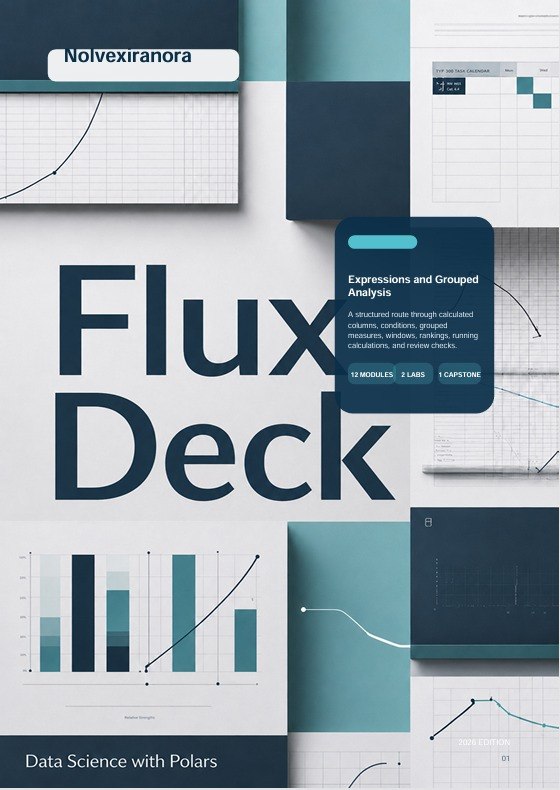
Flux Deck
Flux Deck
Couldn't load pickup availability
- 📄 Digital file available after purchase
- 🗂️ Long-term availability
- 🛡️ Secure checkout
- 🗓️ Content updated in 2026
Self-paced learning overview
Share
Problem Statement
After learning how to prepare and combine datasets, learners often need to perform more detailed calculations. They may need to compare categories, calculate values within groups, create new columns from several conditions, or summarize information across different time periods.
These tasks can become difficult to manage when expressions are written without a clear structure. Repeated calculations, unclear aliases, and long transformation chains may make a workflow harder to read and review.
Solution
Flux Deck introduces analytical expressions through a gradual sequence. Learners begin with arithmetic and conditional calculations before moving into grouped aggregations, window expressions, ranking, and reusable expression patterns.
The course emphasizes clear naming, logical sequencing, and regular result checks. Learners examine how each expression changes a dataset and how several expressions can work together inside one analytical process.
What’s Inside
Flux Deck contains modules covering expression contexts, arithmetic operations, conditional logic, string expressions, date calculations, grouped aggregations, window expressions, ranking, cumulative calculations, and reusable expression groups.
The materials include annotated examples, comparison diagrams, analytical exercises, review questions, workflow notes, and a structured course project.
During the project, learners prepare an analytical dataset, calculate category-level measurements, compare records within groups, and organize the results into a clear summary table.
Who Is This For?
Flux Deck is intended for:
- Learners familiar with data preparation and table joins
- Analysts who want to organize calculations more clearly
- Students studying grouped data analysis
- Developers creating repeatable data transformations
- Learners working with category, date, and numeric information
- People who want to understand expression contexts in Polars
What You’ll Learn
- Distinguish between selection and aggregation contexts
- Create calculated columns from existing values
- Write conditional expressions with several branches
- Apply arithmetic operations to numeric columns
- Work with text values through expression methods
- Extract and compare date components
- Group records by one or more categories
- Calculate totals, averages, counts, and ranges
- Apply several aggregations within one grouped operation
- Use window expressions without reducing row detail
- Rank values within categories
- Create cumulative totals and running calculations
- Compare each record with a group-level value
- Name calculated columns clearly
- Reuse related expression patterns
30-Day Refund Policy
Flux Deck includes a 30-day refund request period, subject to the terms presented on the website. Learners may review the refund conditions before completing a purchase.
Certification
The course includes a certificate of completion, giving learners a clear way to confirm their progress and present a record of the course they completed.
Do I need previous data science experience?
Do I need previous data science experience?
No previous experience is required for introductory tiers. The courses begin with clearly explained concepts and gradually introduce data structures, analytical expressions, workflow planning, and practical data tasks.
How are the courses organized?
How are the courses organized?
Each course is divided into structured modules containing explanations, examples, guided exercises, review sections, and practical activities. Learners can follow the modules in sequence or return to earlier topics when reviewing a concept.
Does every tier include a certificate?
Does every tier include a certificate?
Yes. Each course includes a certificate of completion. The certificate gives learners a clear record that they completed the included lessons, exercises, and course sections.