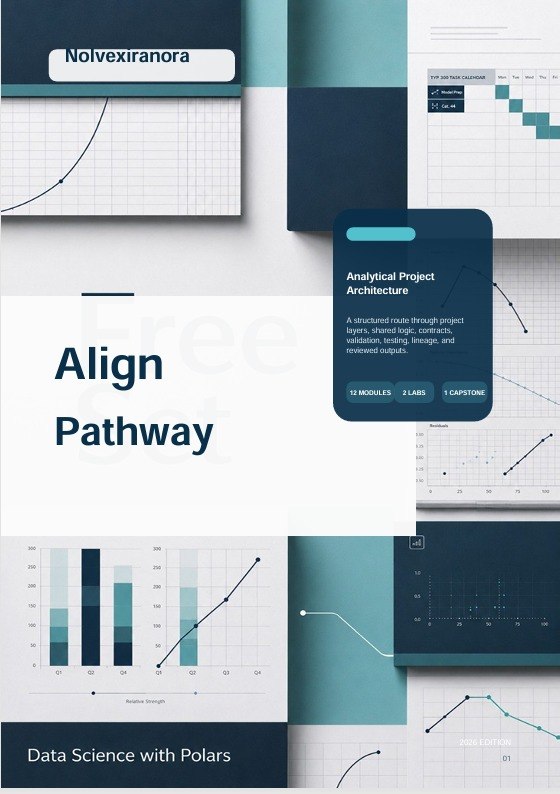
Nolvexiranora
Align Pathway
Align Pathway
Couldn't load pickup availability
- 📄 Digital file available after purchase
- 🗂️ Long-term availability
- 🛡️ Secure checkout
- 🗓️ Content updated in 2026
Self-paced learning overview
Share
Problem Statement
As analytical workflows expand, the challenge is no longer limited to writing individual expressions. Learners may need to coordinate several data sources, preparation rules, calculations, checks, and output formats within one project.
Without a defined structure, related logic can become scattered across long files. Column names may change between stages, repeated calculations may appear in several places, and important assumptions may remain undocumented. This makes the workflow harder to review, update, and explain.
Another issue appears when analytical results are produced without systematic validation. A workflow may complete without errors while still containing unexpected row loss, duplicated records, unsuitable data types, or incomplete category coverage.
Solution
Align Pathway presents analytical project design as a collection of connected components. Learners study how to separate ingestion, preparation, validation, analysis, and output stages while keeping the full process readable.
The course introduces reusable functions, shared expression groups, configuration values, schema expectations, and validation checkpoints. Each module explains how these elements contribute to a consistent project structure.
What’s Inside
Align Pathway contains modules on project architecture, staged workflow design, reusable functions, configuration planning, schema validation, data-quality checks, analytical testing, logging concepts, documentation, and output organization.
The materials include project diagrams, annotated examples, planning worksheets, review questions, validation tables, and a detailed course assignment.
The assignment guides learners through building a complete analytical project from several related datasets. Learners define the project stages, prepare reusable logic, add checks, calculate summary measures, document decisions, and produce organized output tables.
Who Is This For?
Align Pathway is intended for:
- Learners with experience in complete Polars workflows
- Analysts managing multi-stage data projects
- Developers organizing reusable data-processing logic
- Students studying analytical project architecture
- People working with repeated reporting tasks
- Learners who want clearer validation routines
What You’ll Learn
- Divide an analytical project into defined stages
- Organize ingestion, preparation, analysis, and output logic
- Create reusable functions for repeated data tasks
- Build shared groups of Polars expressions
- Store adjustable project values in one clear location
- Define expected schemas for incoming datasets
- Check column names, data types, and required fields
- Compare row counts across workflow stages
- Detect duplicate records and incomplete categories
- Validate joins using matched and unmatched records
- Add checks for missing or unexpected values
- Organize messages that describe workflow activity
- Document data sources and analytical assumptions
- Record the purpose of important transformations
- Prepare structured tables for reporting or later study
- Review the complete project from input to final output
- Refine repeated logic into reusable components
- Present an analytical workflow in a clear project format
30-Day Refund Policy
Align Pathway includes a 30-day refund request period, subject to the conditions displayed on the website. Learners may review the full policy before completing a purchase.
Certification
The course includes a certificate of completion, giving learners a clear way to confirm their progress and present a record of the course they completed.
Do I need previous data science experience?
Do I need previous data science experience?
No previous experience is required for introductory tiers. The courses begin with clearly explained concepts and gradually introduce data structures, analytical expressions, workflow planning, and practical data tasks.
How are the courses organized?
How are the courses organized?
Each course is divided into structured modules containing explanations, examples, guided exercises, review sections, and practical activities. Learners can follow the modules in sequence or return to earlier topics when reviewing a concept.
Does every tier include a certificate?
Does every tier include a certificate?
Yes. Each course includes a certificate of completion. The certificate gives learners a clear record that they completed the included lessons, exercises, and course sections.